
What Is a Secondary Battery? Types, Working Principles, and Manufacturing Processes
A secondary battery is frequently mentioned in news about carbon neutrality.
However, some people may still be unsure what they are or how they differ from primary battery.
This article explains the basics of secondary battery and introduces the roll-to-roll control technologies that play a critical role in their manufacturing process.
About Secondary Batteries
Secondary batteries are rechargeable batteries that can be used repeatedly, unlike primary batteries, which are intended for single use.
They are widely used in applications such as automobiles, smartphones, and residential energy storage systems. Because secondary batteries can be recharged and reused multiple times, they generate less waste and are attracting increasing attention in the context of carbon neutrality.
Major Types of Secondary Batteries
| Lithium-Ion Battery |
Widely used in portable electronic devices and vehicles. Lithium-ion batteries offer high energy density and a long cycle life. Types include ternary lithium-ion batteries and lithium iron phosphate (LFP) batteries, both also used in electric vehicles. |
|---|---|
| Lead-Acid Battery |
Widely used in automobiles and uninterruptible power supplies (UPS). The main materials are lead and an acidic electrolyte. |
| Nickel-Cadmium Battery |
Previously used in mobile phones and tools, but use has declined with the spread of lithium-ion batteries. |
| Nickel-Metal Hydride Battery |
Commonly used in small electronic devices such as mobile phones and digital cameras. |
Promising Secondary Batteries for Future Applications :
All-Solid-State Batteries
Among the various types of secondary batteries, all-solid-state batteries are attracting attention as a promising next-generation battery technology.
While they have a structure similar to that of conventional liquid-electrolyte lithium-ion batteries,
they differ in that they do not use liquid electrolytes.
As a next-generation battery technology, all-solid-state batteries offer high safety, high energy density, and shorter charging times.
In addition, the use of solid electrolytes helps reduce the risk of fire and explosion.
Although they are suitable for high-capacity applications such as electric vehicles, they are still under development and are expected to be commercialized in the future.
How Secondary Batteries Are Made :
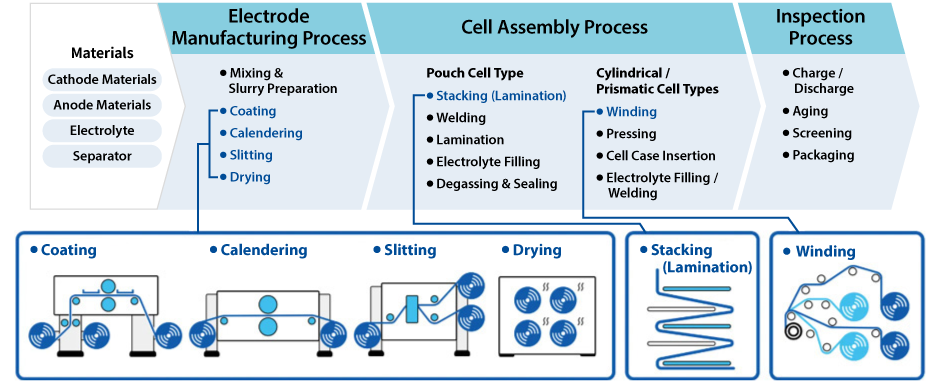
Lithium-Ion Battery Manufacturing Process
Electrodes are manufactured by coating, drying, compressing, and slitting electrode materials.
This is followed by assembly, inspection, and packaging, which together constitute the manufacturing process for secondary batteries.
The process shown here is provided as an example.
Overview of the Secondary Battery Manufacturing Process
Role of Roll-to-Roll Transport Control Technology in Secondary Battery Manufacturing
In the manufacturing of secondary batteries,
we provide roll-to-roll control technologies, particularly for upstream coating processes.
In the coating process, electrode materials must be applied uniformly to metal foil,
requiring both high precision and high production speed.
Achieving both is a critical challenge, as reducing process speed lowers productivity, while insufficient precision can negatively impact product quality.
One of the key technologies for addressing this challenge is tension control based on motor
synchronization control in roll-to-roll systems.
By maintaining constant tension while transporting materials at high speed and with stability, it helps prevent
coating unevenness and wrinkles, enabling both high quality and high productivity.
In addition, electrode coating processes may employ intermittent coating, a technique in which coating material is applied at specific intervals.
This method can cause edge build-up at the beginning and end of the coating area, making consistent quality control essential.
To address this issue, we apply our stage positioning technology to valve actuation control, improving coating performance through advanced control technologies.
In this way, roll-to-roll transport control technology serves as a fundamental technology that supports both the
quality (performance) and production efficiency of secondary batteries.
If you are looking to improve and stabilize the transport accuracy of your existing equipment, please feel free to
contact us.